Jiarui Zhou, Xin Liu, Edward A. Laws, Charlotte Laufkötter, Weinan Li, Jingxiao Wang, Changlin Li, Wupeng Xiao, Yuan Shen, Bangqin Huang
Geophysical Research Letters
https://doi.org/10.1029/2025GL121124
Published: 20 April 2026
Abstract
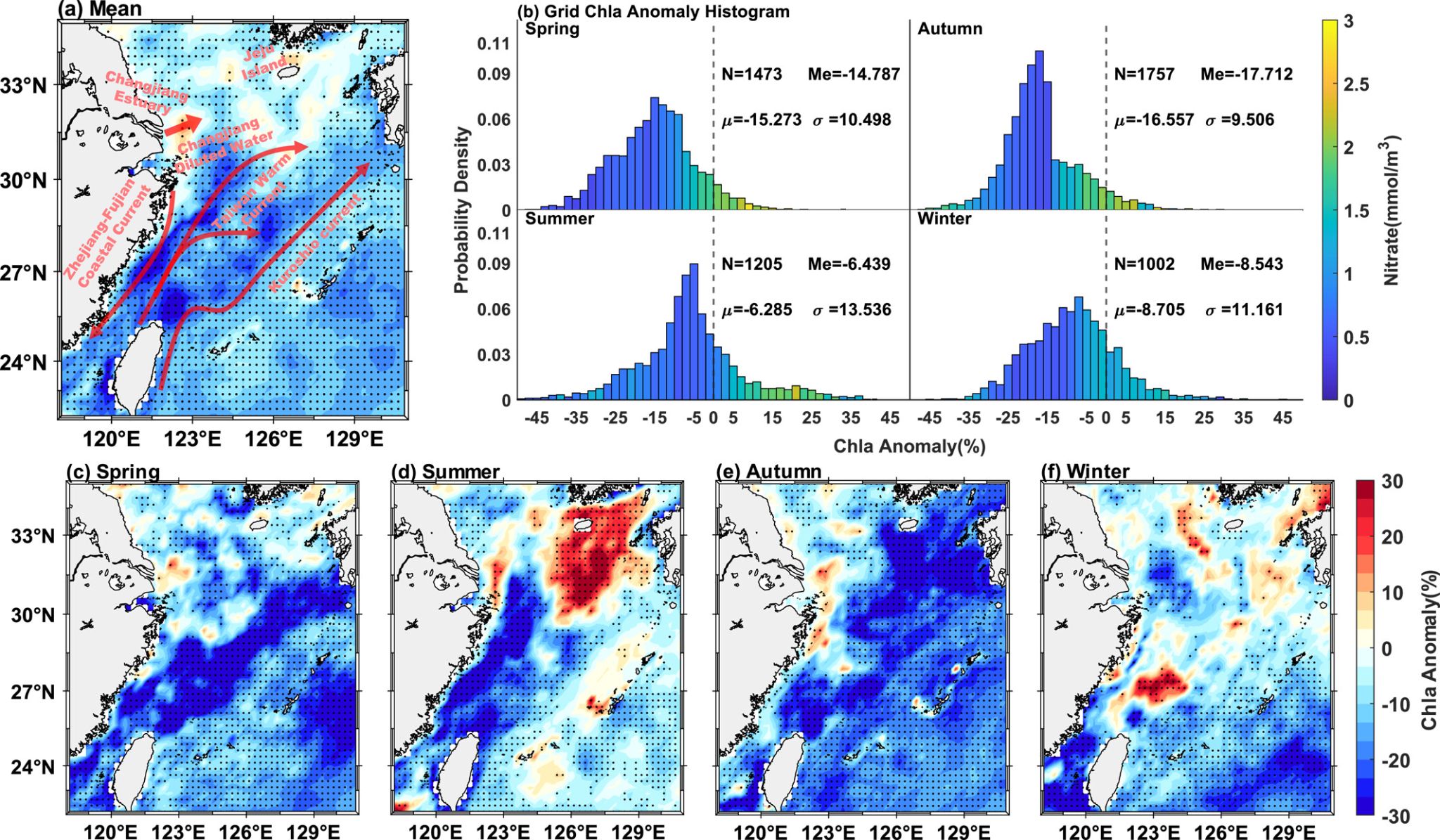
Marine heatwaves (MHWs) profoundly impact marine ecosystems, yet it is unclear how their thermal characteristics shape phytoplankton responses. Using satellite and reanalysis data validated with a multi-year in situ data set from the East China Sea, we show that the intensity and duration of MHWs can contribute to contrasting outcomes, alongside co-varying background conditions, rather than being explained solely by nutrient control. Relative to chlorophyll-a climatology, short-intense events stimulate phytoplankton when surface nitrate exceeds 2.8 mmol m−3, whereas long-weak MHWs suppress phytoplankton unless nitrate rises above 7.3 mmol m−3. At equal cumulative intensity, rapid warming boosts biomass more effectively than gradual warming, but only in nutrient-rich waters. Similar patterns emerge across the global ocean. Because the duration of MHWs tends to increase faster than intensity under global warming, our findings indicate amplified negative impacts from long-weak MHWs, with cascading effects on marine food webs and carbon cycling.