Yao Wang, Xin Luo, Esteban G. Jobbágy, Nandita B. Basu, Ganlin Zhang, Yi Zheng, Baojing Gu, Shaoliang Zhang, Yiqi Yu, Fenfang Wang, Zeyang Lu, Ruifeng Yan, Scott X. Chang, Yonglong Lu & Nengwang Chen
Nature Communications
https://doi.org/10.1038/s41467-026-70277-7
Published: 07 March 2026
Abstract
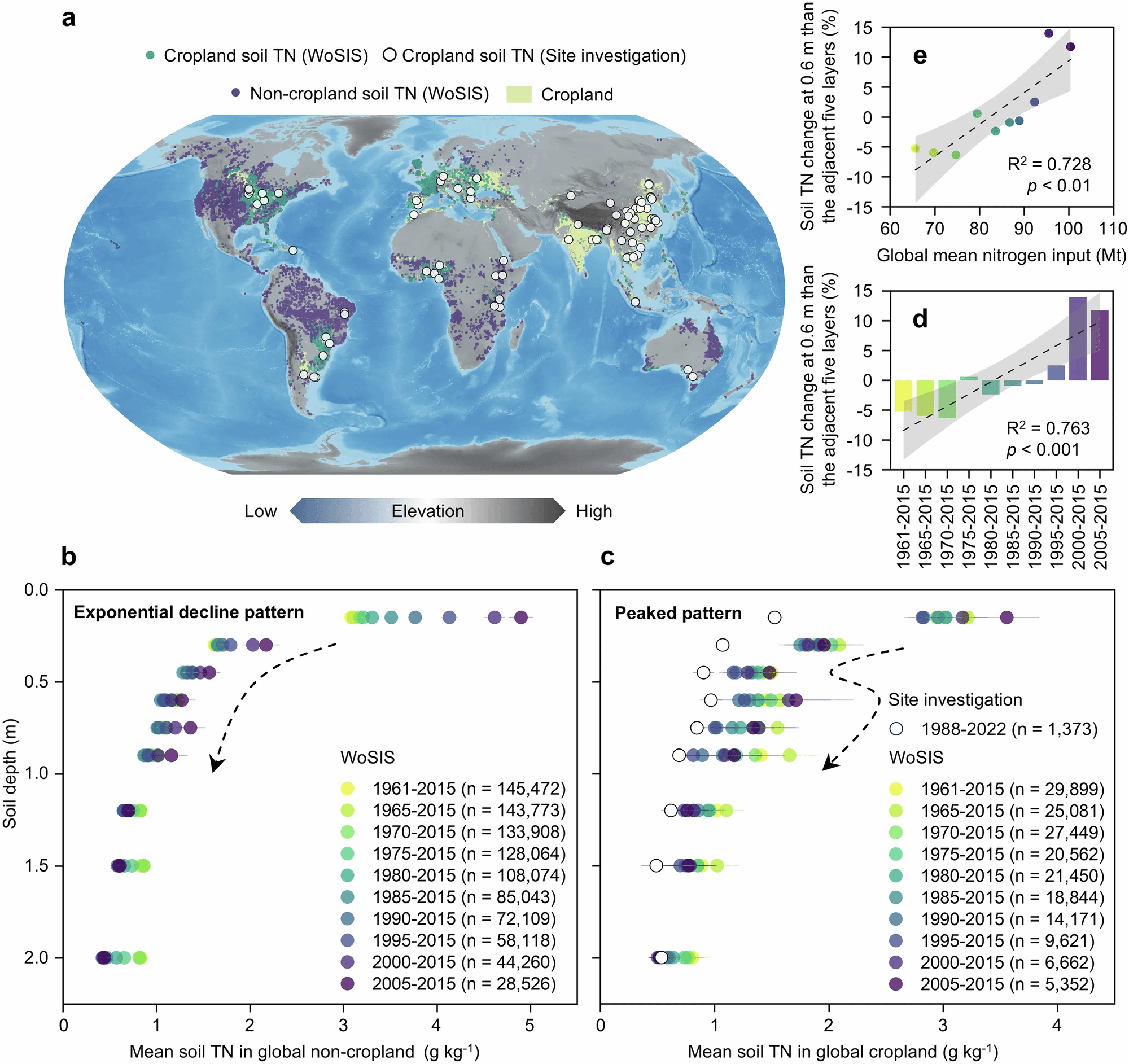
The excessive application of nitrogen fertilizers in croplands drives nitrification-induced nitrogen losses, accelerating soil degradation and groundwater nitrate pollution. By synthesizing global nitrogen profiles and field studies, we identify a previously overlooked “enhanced nitrification layer (ENL)” at approximately 0.6 m depth (ranging from 0.3 to 0.9 m) across global croplands. The formation of the ENL relies on the interplay of four key processes: root-mediated nitrogen transport (the conveyor belt), an oxygenated microenvironment sustained by soil texture (the reaction chamber), nitrifier communities (the nitrification engine), and favorable hydrological conditions (the activating switch). This ENL acts as a biogeochemical hotspot, driving subsoil pH declines and nitrate leaching to groundwater. Its identification establishes a precise subsurface target, expanding nitrogen management to address the critical depth of peak transformation alongside surface measures, thereby advancing agroecosystem sustainability.